
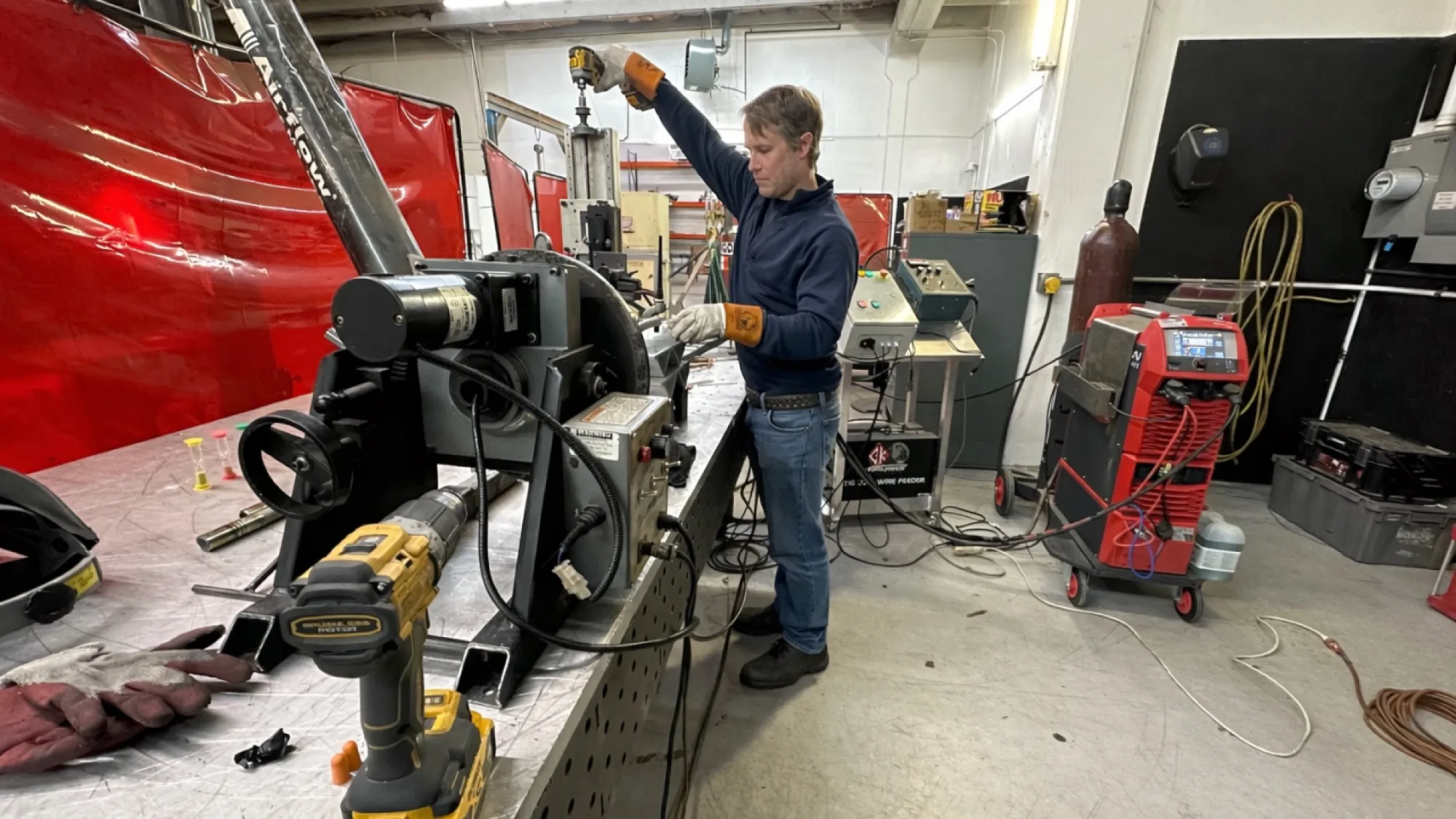
We recently put our shop-made orbital welding machine to work laying beads on Inconel 617, a nickel-based superalloy known for its strength at extreme temperatures and its reputation for being less than forgiving.
What started as a concept evolved into a tightly integrated system of mechanical control, electronics, and advanced welding parameters. More importantly, it became a case study in what it takes to move from prototype hardware to production-ready automation.
The system architecture
- Variable speed rotator. Controlled part rotation, the foundation of consistent orbital weld geometry.
- Torch holder assembly. Manual rough adjustment for setup and alignment, plus servo-controlled fine adjustment for precise torch positioning during operation.
- The brain. A white NEMA enclosure housing an Arduino microcontroller, a digital potentiometer controlling the rotator, a servo with a 1k analog potentiometer controlling the welder, a switching system for the TIG wire feeder, and 408 lines of Arduino code.
- Arc voltage controller. Maintains consistent torch height, critical for out-of-round parts, dimensional inconsistencies, arc stability, and repeatable penetration.
- Fronius iWave 300. The power source central to the system's performance.
The real challenge: electromagnetic interference
High-frequency TIG starts introduced EMI that initially caused Arduino CPU resets. Solving it took layered mitigation:
- High-frequency arc grounding
- Coded hard stops based on calculated runtime
- CPU reboot safeguards
- Improved physical grounding
- Cleaned-up cable routing
Dialing in the weld: heat input and arc control
Ultra-high frequency pulse. Fronius ultra-high frequency pulse allowed stable puddle control, reduced thermal input, and improved bead consistency.
Data-driven parameter transfer. Manual welding parameters were transferred directly into the automated system, dramatically reducing development time.
What this means for scaling
- Mechanical precision
- Electrical robustness
- Software safeguards
- Process validation
- Data-driven refinement
When advanced welding techniques are paired with a problem-solving mentality, it is possible to create order-of-magnitude improvements in consistency, throughput, and scalability. If you are moving high-performance prototypes into repeatable production, we would love to connect.